There is a gut reaction many of us have when we see something online that seems too affordable: If it is this cheap, something must be wrong with it.
We understand that instinct. For decades, we have been trained to equate higher prices with higher quality. And in some cases, that correlation holds. But in the world of online shopping in 2026, the relationship between price and quality has fundamentally changed. Understanding why can save you money and help you make better purchasing decisions.
So let us talk about what actually drives the price of the products you buy, and why the number on the tag might be telling you less about quality than you think.
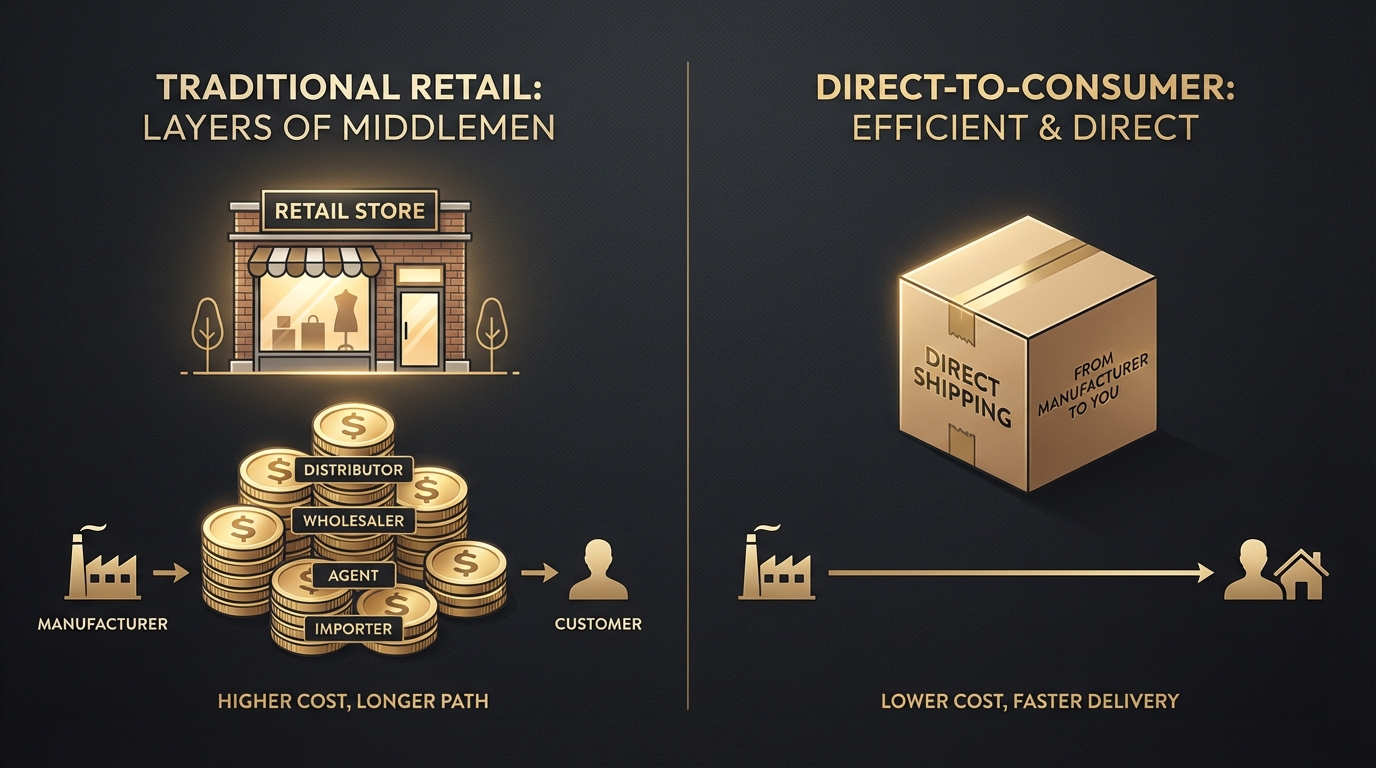
The Traditional Retail Markup Chain
To understand why trending products can be affordable without being low quality, you first need to understand where your money goes when you buy something through traditional retail channels.
Here is the simplified version of how a product typically gets from a factory to your hands:
- The manufacturer produces the product. Their costs include raw materials, labor, factory overhead, and quality control. They sell the product at a margin to cover these costs and make a profit.
- The distributor buys from the manufacturer, typically adding a 15-30% markup. They handle warehousing, logistics, and regional distribution.
- The retailer buys from the distributor, adding another 50-100% markup (sometimes more). This covers rent for physical stores, staff wages, advertising, inventory risk, and their own profit margin.
- You, the customer, pay the final price, which often reflects two or three layers of markup on top of the actual production cost.
By the time a product sits on a department store shelf, its price may be three to five times what it cost to produce. That does not mean the product is three to five times better than what you could get at the production price. It means three to five entities each took their cut along the way.
The price you pay at a traditional retailer is not a reflection of the product's quality. It is a reflection of how many hands it passed through to reach you.
How Direct-to-Consumer Changes the Math
The direct-to-consumer model, which is what we and many online stores use, compresses that chain dramatically. Instead of the four-step process above, it often looks like this:
- The manufacturer produces the product.
- The store sources directly from the manufacturer (or works closely with their distribution arm), curates the selection, and sells directly to you.
That is it. Two steps instead of four. The distributor markup is gone. The retail markup is gone. The cost of maintaining a physical storefront with staff, signage, and expensive commercial leases — gone.
This does not mean the product is any different. The same factory, the same materials, the same production process. What changed is the path it takes to reach you. And that path is where most of the cost traditionally lived.
The Difference Between "Cheap" and "Value-Priced"
This is where a lot of shoppers get tripped up, and we think it is worth being really clear about.
"Cheap" means corners were cut in production. Lower-quality materials, less rigorous quality control, shorter product lifespans. You pay less, but you get less.
"Value-priced" means the production quality is solid, but the price is lower because the business model is more efficient. You pay less because the company found a smarter way to get the product to you, not because they made a worse product.
Think about it this way: imagine a well-made tech accessory. The materials cost a certain amount. The engineering and design cost a certain amount. The quality testing costs a certain amount. None of that changes based on whether the product is sold in a department store or directly online. What changes is everything that happens after production.
Real-World Example
A tech accessory that costs the same amount to manufacture might sell for significantly more at a traditional retailer than at a direct-to-consumer store. Same factory, same materials, same quality control. The difference is entirely in the distribution path and overhead.
How We Source Products and Keep Prices Fair
We want to be transparent about how we approach this at CartClick, because we think the process itself is part of the value.
Direct sourcing
We work directly with manufacturers and their authorized distribution partners. We skip the middlemen who traditionally sit between the factory and the customer. This alone accounts for a significant reduction in the final price compared to what you would pay at a brick-and-mortar store.
Curated catalog
We do not try to sell everything. Our catalog of around 60 products is intentionally small compared to the massive marketplaces. This is a deliberate choice. A smaller catalog means we can test each product more thoroughly, negotiate better terms with suppliers, and manage inventory more efficiently. Less waste, less overstock, lower costs that we pass on to you.
No expensive storefronts
We operate online. We do not pay rent for prime retail locations. We do not employ floor staff or maintain expensive displays. Our overhead is a fraction of what a traditional retailer spends, and that shows in our pricing.
Testing before stocking
Every product in our catalog goes through a vetting process before we agree to sell it. We have written about how curated stores test products in more detail, but the short version is: we try it ourselves, we evaluate the build quality, and we make sure it does what the manufacturer claims. If it does not pass our standards, we do not sell it, no matter how good the margin looks.
This testing process actually saves money in the long run. Products that get returned cost us far more than the cost of testing them upfront. By being selective, we keep return rates low and customer satisfaction high, which in turn keeps our costs down.
Why Low Price Does Not Equal Low Quality
Let us put this into concrete terms with category-level examples.
Tech accessories: A well-engineered phone accessory uses the same type of materials whether it is sold through a major retail chain or through a direct-to-consumer store. The circuit board does not know who sold it. The difference in shelf price between the two channels can be substantial, but the product quality can be identical.
Smart home devices: A clever home gadget designed to solve a specific problem — say, automating a daily task — might use a simple microcontroller and a well-designed housing. The components are affordable. The engineering is smart, not expensive. But route it through traditional retail with its markups, and the price doubles for no improvement in functionality.
Health and wellness gadgets: Products in this category often have straightforward electronics inside. What makes them good or bad is the thoughtfulness of the design and the quality of the materials, not the price tag. A direct-to-consumer health gadget can be just as effective as one sold at a premium through a chain pharmacy.
Smart shopping is not about finding the lowest price. It is about understanding what you are actually paying for and making sure your money goes toward the product, not the supply chain.
What to Watch For (Because Some Low Prices Are Red Flags)
We do not want to pretend that every affordable product is a great deal. Some genuinely are too good to be true. Here is how to tell the difference:
- The store has no return policy or customer support: This suggests they do not expect to be around long enough to handle problems. A legitimate value-priced store will have clear trust signals.
- Product descriptions are vague or copied: Stores that invest in their products write original, detailed descriptions. If the listing reads like it was auto-translated or pulled from a factory spec sheet, proceed with caution.
- No reviews, no social proof, no company information: A store that is proud of its products and its process will be transparent about who they are.
- Prices that are dramatically below market: If something is 80% cheaper than everywhere else, that is worth questioning. But 20-40% less than traditional retail? That is often just the D2C advantage at work.
Reframing "Affordable" as Smart
We think the conversation around pricing needs to shift. "Affordable" has become loaded with negative connotations that do not always apply. In many cases, an affordable product from a direct-to-consumer store is not a compromise. It is simply a smarter path between the factory and your doorstep.
The brands that charge premium prices are not always offering premium products. Sometimes they are offering premium distribution chains, premium retail experiences, and premium marketing budgets. Those things cost money, and that money comes from your pocket.
We would rather put our resources into finding great products, testing them thoroughly, and getting them to you efficiently. The savings from cutting out the middlemen go into two places: lower prices for you and better support when you need it.
The next time you see a product online that seems surprisingly affordable, ask yourself: Is this cheap, or is this just direct? The answer might change how you shop.